
The DfT has published its latest estimates of drink-drive collisions and casualties, showing a welcome reduction in fatalities and serious injuries during 2024, although the overall number of casualties has remained broadly unchanged.
The figures estimate that between 190 and 250 people were killed in drink-drive collisions during 2024, with a central estimate of 220 fatalities. This represents a 16% reduction compared with the 2023 central estimate of 260 deaths.
The number of people killed or seriously injured (KSI) in drink-drive collisions also fell, declining by 6% from around 1,860 in 2023 to approximately 1,740 in 2024.
However, the total number of casualties of all severities changed very little year-on-year, increasing slightly from around 6,310 in 2023 to approximately 6,350 in 2024.
The annual publication estimates the number of reported road collisions in Great Britain involving at least one driver or rider over the legal alcohol limit.
As with previous years, the figures are estimates because they rely on coroners’ and procurators fiscal data that are not immediately available following collisions.
Reacting to the statistics, the Lock Out Drink Driving Campaign said that while any reduction in drink-drive deaths is welcome, but fatality figure “remains an appalling and entirely preventable toll”.
The campaign says: “Behind every number is a family grieving and a community living with the lasting consequences of someone choosing to drive while impaired.
“For far too long, drink-driving has remained a stubborn stain on Britain’s roads, despite being one of the most preventable causes of death and serious injury. It is time to turn words into action and for the Government to embrace practical, evidence-led measures that can stop an impaired driver before they put the key in the ignition.
“Alcohol interlocks can provide a final line of defence by preventing a vehicle from starting when a driver is over the limit, stopping a potentially fatal journey before it begins. The technology to save lives already exists. We now need the Government to act with urgency, publish its response to the road safety consultation and set out a clear route towards putting this proven intervention into practice.”
Hunter Abbott, managing director of personal breathalyser firm AlcoSense Laboratories, said Britain had achieved remarkable progress in reducing drink-drive deaths over the past four decades, but warned there was no room for complacency.
He said: “The evidence suggests we’ve reached the point where the measures that transformed road safety over the last forty years are delivering diminishing returns.
“If we want to prevent more families receiving that devastating knock on the door, we now need the next generation of road safety measures to drive these figures down even further.”
The Government is currently considering changes to drink-drive laws as part of its forthcoming Road Safety Strategy, including reducing the legal alcohol limit in England and Wales from 80mg to 50mg of alcohol per 100ml of blood.
Abbott believes this should form part of a wider package of reforms designed to reduce drink-driving still further.
He added: “Lowering the legal alcohol limit would help identify more impaired drivers before they cause a collision.
“But it shouldn’t be seen in isolation. A lower limit, stronger enforcement, wider use of roadside breath testing and continued public education all have a role to play.”
Figures confirm fall in road deaths in 2025
The DfT has published its final reported road casualty statistics for Great Britain for 2025, confirming a reduction in road deaths but a rise in the number of people killed or seriously injured.
The figures show that 1,556 people were killed on Britain’s roads during 2025 – 46 fewer than in 2024, representing a 3% reduction.
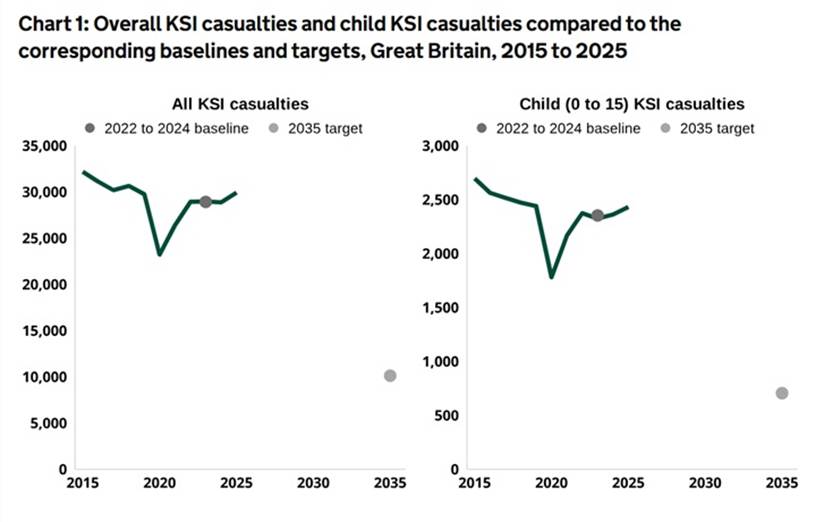
However, the number of people killed or seriously injured (KSI) increased by 4% to 29,911, while the total number of reported casualties remained broadly unchanged at 127,870.
Compared with 2015, the longer-term picture remains one of improvement. Fatalities have fallen by 10%, KSIs by 7%, and total reported casualties by 31%, largely driven by reductions in slight injuries.
However, the latest figures suggest progress has slowed in recent years, with serious injuries moving in the wrong direction despite the continued fall in fatalities.
First benchmark against new Road Safety Strategy
The publication provides the first full annual casualty dataset since the Government launched its new Road Safety Strategy in January 2026, introducing national casualty reduction targets for the first time in more than a decade.
The strategy commits to reducing the number of people killed or seriously injured by 65% by 2035, alongside a 70% reduction in child KSIs, against a 2022-2024 baseline.
A rise in the total number of KSIs is also matched by an increase in a number of reported child KSI casualties (under 16). The 2025 figure of 2,432 represents an increase of 3% compared with the 2022 to 2024 baseline average of 2,353.
The strategy also adopts a Safe System approach, recognising that while human error cannot be eliminated, the transport system should be designed so that mistakes do not result in death or life-changing injury.
Against that backdrop, the 2025 figures provide an early indication of the scale of the task ahead. While fewer people lost their lives on Britain’s roads last year, almost 30,000 people were killed or seriously injured, demonstrating that substantial and sustained action will be required if the 2035 targets are to be achieved.
Mixed picture across road user groups
The DfT figures reveal differing trends across road user groups.
Among the headline findings:
The department notes that annual casualty numbers can fluctuate and should be interpreted alongside longer-term trends. Nevertheless, the increase in serious casualties among vulnerable road users will be a concern for road safety professionals.
The statistics also show that:
James Gibson, executive director of Road Safety GB, said: “Although the reduction in fatalities is encouraging, the increase in serious injuries demonstrates that Britain remains some distance from achieving its long-term ambition of dramatically reducing the human and economic cost of road crashes.
“For local authorities and road safety partnerships, the latest figures reinforce the importance of continuing to deliver evidence-led interventions that tackle the principal causes of fatal and serious collisions, while protecting those road users at greatest risk.”